




Engineering1986 > สาระความรู้ > Overhaul Mud Pump Diesel Engine: A Critical Maintenance Process for the Petroleum Industry
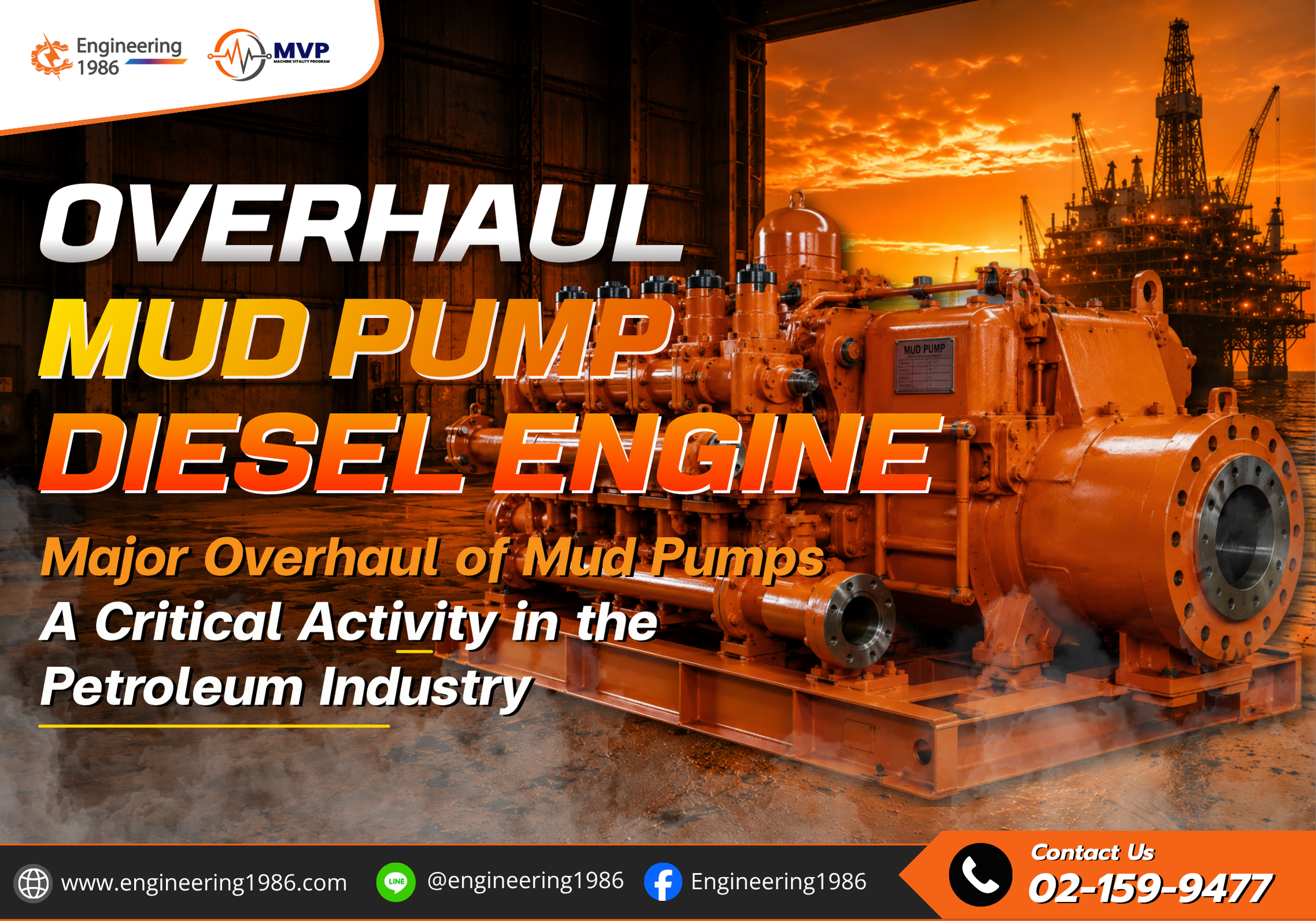
In the world of the petroleum and energy exploration industry, whether operating onshore or offshore, operators and field engineers face one common challenge: working against time under immense pressure.
Drilling operations require substantial investments in technology, equipment, and highly skilled personnel. With drilling rigs operating around the clock, every minute of operation represents a significant cost. As a result, even the smallest interruption can have serious financial consequences.
Risk management is therefore a critical aspect of the Oil & Gas industry. Unplanned downtime, even if it lasts only a few minutes, can lead to losses worth millions of dollars. Such disruptions not only affect operational efficiency but can also impact project schedules, safety performance, and overall profitability.
For this reason, maintaining the reliability of critical equipment is essential. Among the most important systems in drilling operations is the Mud Pump Diesel Engine, the primary power source responsible for driving mud circulation throughout the wellbore. Ensuring its optimal performance through regular inspection, preventive maintenance, and major overhaul services is a key strategy for minimizing operational risks and maximizing equipment availability.
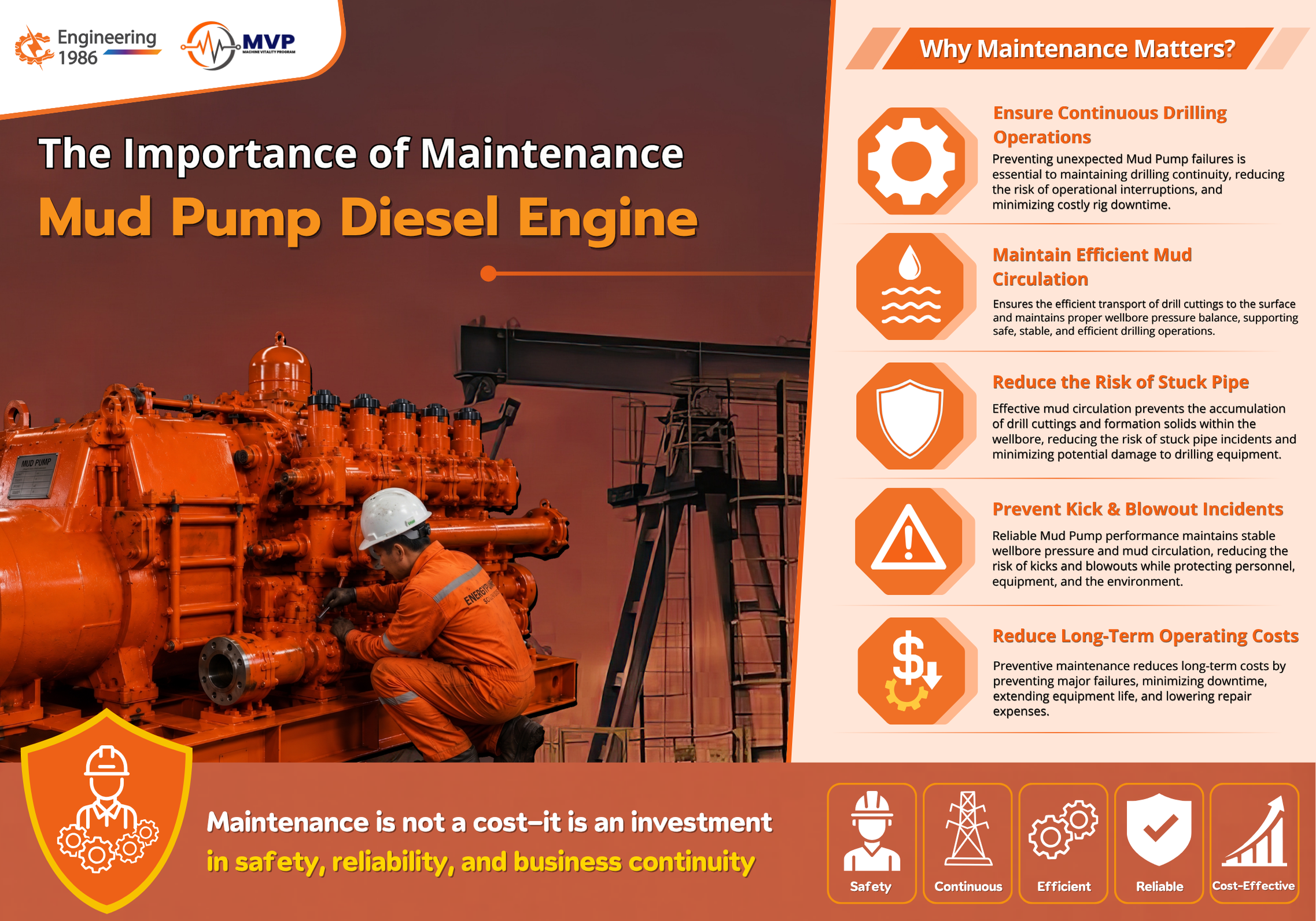
The Importance of Mud Pump Diesel Engine Maintenance
An oil drilling rig does not operate as a standalone system. Instead, it functions through a complex chain of interconnected mechanical systems, where every component plays a critical role in maintaining operational continuity.
Among these critical systems is the Mud Pump, which serves as the heart of drilling fluid circulation. If a mud pump experiences an emergency failure or unexpected shutdown, the entire fluid circulation process can come to an immediate halt. As a result, drilling operations are forced to stop, leading to costly downtime and operational delays.
Without continuous mud circulation, drilling fluid can no longer transport rock cuttings and formation solids out of the wellbore. These materials begin to settle and accumulate inside the hole, significantly increasing the risk of stuck pipe incidents. In addition, the loss of proper mud circulation can disrupt wellbore pressure control, potentially creating hazardous conditions that may compromise drilling safety and well integrity.
In severe cases, such failures can lead to major wellbore damage, resulting in substantial repair costs and recovery efforts that may require weeks to complete. For this reason, regular inspection, preventive maintenance, and timely overhaul of the Mud Pump Diesel Engine are essential to ensure reliable performance, minimize operational risks, and maintain uninterrupted drilling operations.
A sudden loss of drilling fluid circulation and pressure control can significantly increase the risk of a well control incident, potentially leading to a Kick or Blowout. These events are among the most serious hazards in the Oil & Gas industry, posing severe threats to personnel safety, environmental protection, and asset integrity.
For this reason, investing in highly reliable equipment and implementing a comprehensive Preventive Maintenance and Overhaul Program in accordance with international standards is far more than a routine maintenance practice. It is a critical business strategy that safeguards valuable assets, protects operational continuity, and strengthens the financial stability of petroleum operations.
By proactively maintaining critical equipment such as Mud Pump Diesel Engines, operators can minimize the risk of unexpected failures, reduce costly downtime, enhance operational safety, and ensure smooth and efficient drilling performance. Ultimately, effective maintenance transforms million-dollar risks into reliable, productive, and safe operations every minute of every day.
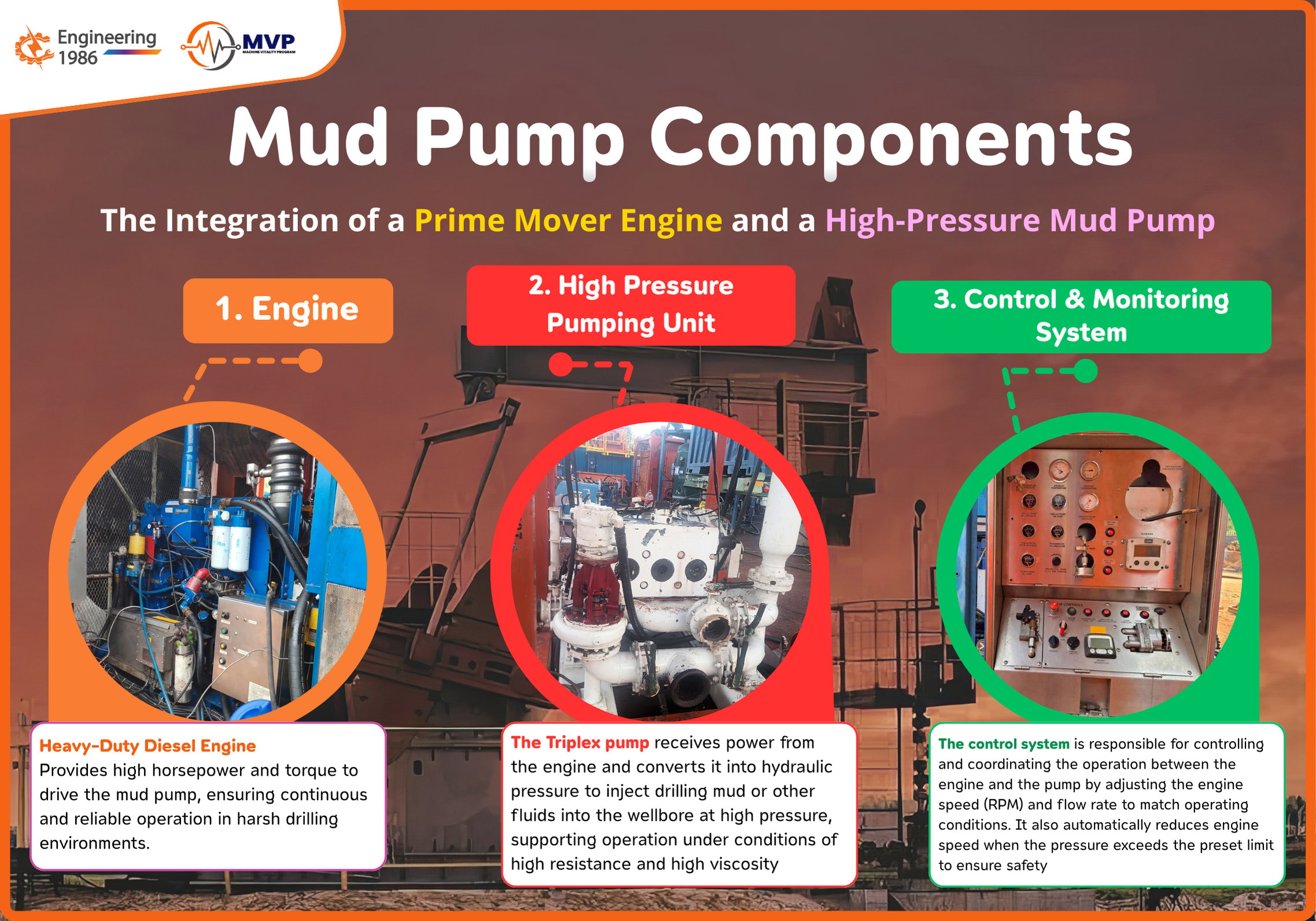
Mud Pump Structure: The Integration of Power Between the “Prime Mover Engine” and the “High-Pressure Hydraulic Pump”
If an oil drilling rig is compared to the human body, the Mud Pump can be considered the muscular system that supports and sustains the rig’s critical operations. It plays a vital role in maintaining drilling fluid circulation and ensuring the smooth execution of drilling activities.
From an engineering perspective, a Mud Pump Unit does not operate as a standalone piece of equipment. Instead, it is the result of the seamless integration of two primary power components, coordinated and monitored by an intelligent control system. Together, these elements work in harmony to deliver the performance, reliability, and pressure control required for safe and efficient drilling operations.
The Mud Pump Unit consists of two major power components and one intelligent control system, as follows:
1. Prime Mover (Diesel Engine)
The diesel engine serves as the “muscle power” of the Mud Pump Unit, generating the high horsepower and torque required to drive drilling operations. In the petroleum industry, heavy-duty diesel engines—such as the Detroit Diesel Series 60 rated at approximately 600 horsepower—are commonly selected due to their ability to operate continuously under high loads for extended periods in harsh and demanding environments.
The primary function of the engine is to convert fuel energy into mechanical power and transmit it to the mud pump system. This mechanical energy enables the pump to maintain the high-pressure drilling fluid circulation essential for wellbore cleaning, cuttings transport, pressure control, and overall drilling efficiency.
Because the diesel engine operates at sustained speeds and heavy loads throughout drilling activities, maintaining its reliability through regular inspection, preventive maintenance, and scheduled overhauls is critical to ensuring uninterrupted operations and minimizing the risk of costly downtime.
2. High-Pressure Pumping Unit
The High-Pressure Pumping Unit acts as the “muscle” of the Mud Pump System, receiving mechanical power from the diesel engine and converting it into hydraulic pressure. In Oil & Gas drilling operations, Triplex Pumps—three-piston reciprocating pumps such as those manufactured by WEIR SPM—are widely used due to their durability, efficiency, and ability to deliver consistent high-pressure performance.
The primary function of the pumping unit is to generate discharge pressure and circulate drilling fluid (mud) into the wellbore. These systems are capable of operating at pressures of up to 4,000 PSI or higher, enabling them to overcome the resistance and high viscosity of drilling mud while maintaining continuous fluid circulation throughout the drilling process.
By delivering drilling fluid under high pressure, the pump supports several critical functions, including cuttings removal, wellbore cleaning, drill bit cooling, lubrication, and well pressure control. As one of the most heavily loaded components in the drilling system, the High-Pressure Pumping Unit requires regular inspection, maintenance, and overhaul to ensure maximum reliability and operational efficiency.
3. Control & Monitoring System
The most indispensable component of the Mud Pump Unit is the “software brain” that connects, coordinates, and controls the two primary systems the diesel engine and the high-pressure pumping unit ensuring they operate together as a single integrated system.
This intelligent Control & Monitoring System serves as the central command platform, continuously managing operational performance while maintaining safe and efficient drilling conditions. By synchronizing power generation and fluid delivery, it helps maximize equipment reliability, optimize performance, and minimize operational risks.
The Control & Monitoring System performs two critical functions:
3.1. Integrated Control
The Control System synchronizes engine speed (RPM) with the pump flow rate to ensure precise and efficient operation under varying drilling conditions. This coordinated control allows the diesel engine and mud pump to function as a unified system, optimizing performance while protecting critical equipment.
If discharge pressure exceeds predefined safety limits, the system can automatically reduce engine speed to prevent overload conditions, minimize mechanical stress, and maintain safe operating parameters.
3.2. Monitoring & Reporting
The Monitoring System continuously measures, records, and reports critical operating data from both the diesel engine and the high-pressure pumping unit in real time. Key parameters include engine RPM, exhaust gas temperature (EGT), mud discharge pressure, flow rate (BPM), fuel consumption, and other essential performance indicators.
This real-time visibility enables field engineers to analyze equipment performance, assess thermal loading, identify abnormal operating conditions, and implement corrective actions before failures occur. As a result, operators can significantly reduce the risk of unplanned downtime, improve equipment reliability, and enhance overall drilling efficiency.
The successful synergy between a high-performance diesel engine, a robust high-pressure mud pump, and an intelligent control system is the foundation of every reliable Mud Pump Unit. By working together as a fully integrated system, these components provide the power, pressure, and precision required to sustain safe and efficient drilling operations.
Their combined performance enables the petroleum industry to maintain continuous production, reduce unplanned downtime, enhance operational safety, and ensure reliable energy exploration and drilling activities around the clock.
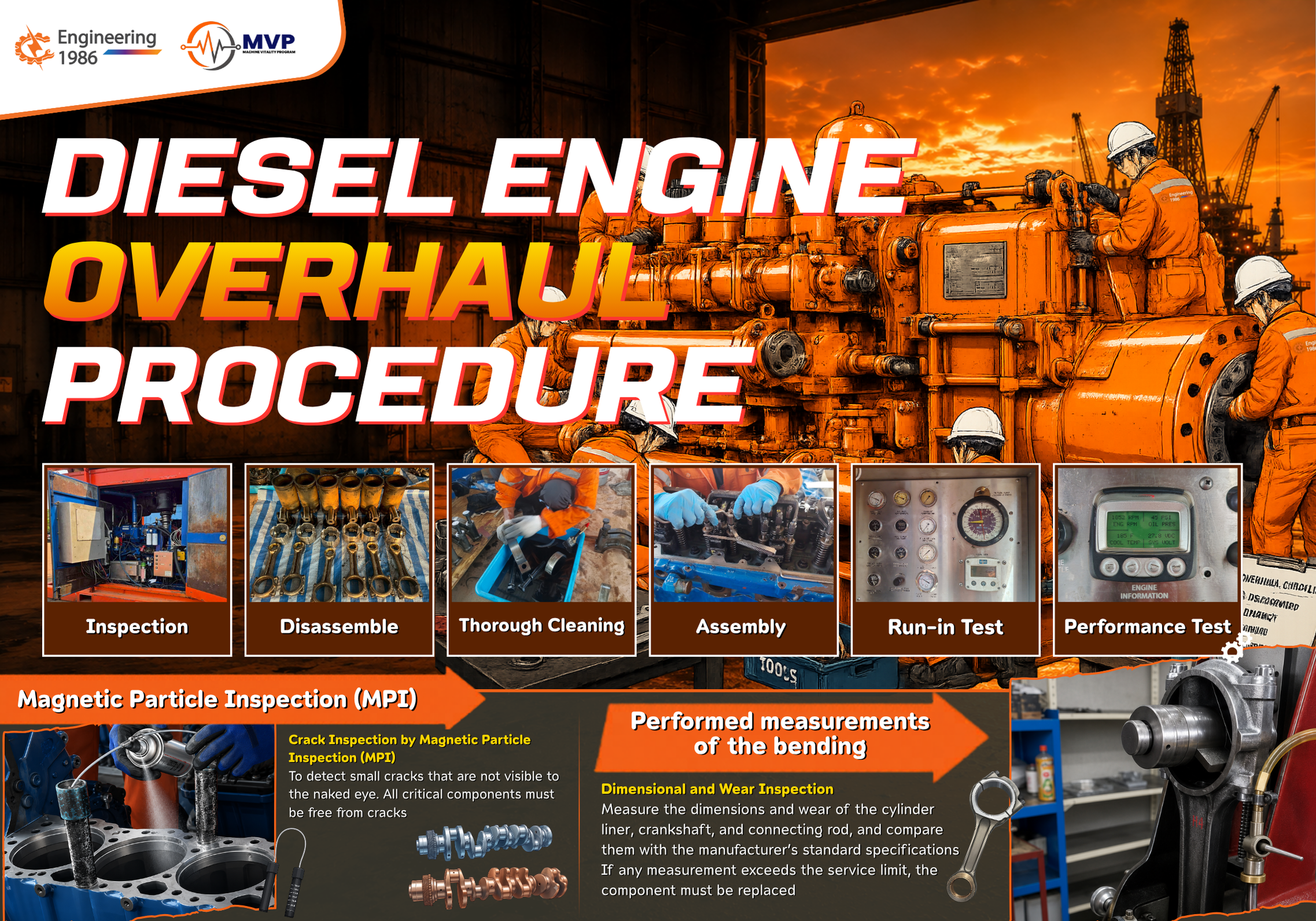
Mud Pump Diesel Engine Overhaul: A Critical Preventive Maintenance Strategy for the Petroleum Industry
The overhaul of a high-speed diesel engine used to drive a Mud Pump, such as the Detroit Diesel Series 60, involves far more than routine disassembly and cleaning. It is a comprehensive engineering process that requires precision workmanship, detailed inspection, and strict adherence to Original Equipment Manufacturer (OEM) specifications and standards. Proper overhaul procedures are essential to restoring engine performance, ensuring operational reliability, and minimizing the risk of unexpected downtime in critical oilfield operations.
To restore the engine to 100% operational efficiency, the overhaul process is typically divided into four key stages:
- Preparation & Dismantling
Every activity on a drilling rig begins with safety. Prior to isolating and disconnecting all energy sources, the maintenance team conducts a comprehensive Safety Briefing / KY (Kiken Yochi) Meeting to review the work scope, identify potential hazards, and establish risk control measures. Once all safety requirements have been verified, the engine and its associated systems are prepared for systematic dismantling and detailed inspection.
- Work Process
The overhaul process begins with the complete draining of all operating fluids, including lubricating oil and engine coolant. Once the system has been safely isolated, external auxiliary components such as hydraulic lines, the radiator, and the oil cooler are removed from the containerized package to provide full access to the engine assembly.
- Engine Disassembly
The maintenance team then proceeds with a systematic disassembly of the engine in accordance with OEM procedures. Major components are removed sequentially, starting with the valve covers, intake and exhaust manifolds, turbocharger assembly, camshaft, and fuel injectors. The process continues with the separation of the cylinder head from the engine block, followed by the removal of the piston assemblies and crankshaft for detailed inspection and evaluation.
- Inspection & Measurement
This is the most critical stage of the overhaul process. Major engine castings in a Mud Pump power unit are exposed to extreme torque, pressure, and continuous operating loads. As a result, any defect, no matter how small, is unacceptable. Thorough inspection and precision measurement are therefore essential to ensure reliability, safety, and compliance with OEM standards.
- Cleaning Process
All engine components are thoroughly cleaned using specialized industrial cleaning agents to remove carbon deposits, sludge, grease, and oil contaminants. After cleaning, the parts are properly sealed and protected with plastic wrapping to prevent contamination before inspection and reassembly.
- Crack Detection (MPI Inspection)
Critical structural components such as the crankshaft, connecting rods, and cylinder head must undergo Magnetic Particle Inspection (MPI) in accordance with ASTM E1444 standards. This non-destructive testing method is used to detect hairline cracks and surface discontinuities that are invisible to the naked eye. These critical components are subject to a Zero-Tolerance Acceptance Criteria, meaning that any crack indication will result in immediate rejection or replacement of the part.
- Dimensional Measurement
Detailed dimensional inspections are performed on cylinders, crankshafts, and connecting rods using precision measuring instruments such as micrometers and bore gauges. Parameters including diameter, out-of-roundness, taper, and runout are carefully measured and compared against the manufacturer’s service limits and OEM specifications. Any component found to exceed the allowable wear limits must be repaired or replaced to ensure optimal engine performance and reliability.
- Assembly & Torque Setting (Assembly & Rebuilding)
Once all components have been inspected and sorted, and new spare parts have been prepared (such as piston ring sets, pistons, and new cylinder liners), the reassembly process will begin
– Work Process
The technicians will carefully install the crankshaft, fit the cylinder liner, and reassemble the piston and connecting rod back into the engine block with precision.
– Accuracy
All cylinder head bolts, connecting rod bolts, and main bearing bolts must be tightened using a torque wrench according to the torque values and tightening angles specified by the OEM in the maintenance manual only. This is to prevent issues such as bolt loosening or bolt failure during operation.
- Full System Performance Test & Sign-off
After the overhauled engine has been reinstalled into the soundproof enclosure and connected to the gearbox and the triplex hydraulic pump, a full operational performance test must be carried out. This testing process is conducted to verify the engine’s overall performance, ensure all systems are functioning properly, and generate a final service report as a guarantee of work quality.
– Run-in Test
The engine is operated without load continuously (e.g., for 8 hours) to inspect the lubrication system, engine oil pressure, and cooling system, ensuring there are no abnormalities or overheating issues.
– Load Performance Test
The gearbox system is coupled and the discharge pressure is applied to the triplex pump to generate high counter-pressure (e.g., testing at 4,000 PSI with engine speed above 1,800 RPM). During the test, an infrared thermal scan is conducted to monitor critical hot spots throughout the entire process.
– Delivery
All technical data, pressure graphs, and test results are collected and compiled into a complete overhaul report, which is then delivered to the customer for official project closure.
The key to maintaining on-site operational stability is carrying out a systematic Preventive Maintenance (PM) program. One of the most effective maintenance practices for a mud pump system is performing a properly scheduled engine overhaul based on operating intervals, ensuring reliability, reducing unexpected downtime, and extending equipment service life
An engine overhaul with Engineering 1986 helps eliminate risks before they develop into major failures, while increasing confidence in parts inspection through complete disassembly, detailed inspection, and hidden crack detection using Magnetic Particle Inspection (MPI) in accordance with international standards. This process allows metal fatigue within critical components to be detected early—before sudden breakage occurs during actual operation.
The overhaul restores engine performance back to 100% by replacing all overhaul kit components according to the engine manufacturer’s specifications, whether for engines from Detroit Diesel, John Deere, Doosan, or other leading engine manufacturers. By replacing worn components based on the OEM service limits and applying precise torque settings, the overhaul ensures stable horsepower and torque output—providing the power needed to drive the Triplex Pump efficiently and generate high pressure against deep rock formations during drilling operations.
Turn Million-Dollar Risks into Confidence with International Standard Overhaul Services by Engineering 1986
From the complex engineering challenges and critical maintenance processes of Mud Pump engines, it is clear that delays or selecting an inexperienced service provider can result in business losses beyond measure.
At Engineering 1986, we specialize in high-performance engine overhaul services for the petroleum and drilling industries. Our major maintenance operations are driven by a team of professional engineers with specialized field experience. We implement advanced management systems, precise work planning, and accurate reporting under the Denwacho methodology—recognized as one of the highest maintenance standards from Japan.
Why Choose Our Overhaul Service?
Specialized Engineers & Technicians
Every component is controlled, inspected, and assembled by our expert engineering team according to OEM service limits and factory standards.
Denwacho Planning & Reporting System
Our Denwacho documentation system provides complete pre-work planning, detailed technical measurement reports, high-pressure performance test graphs, and clear progress updates at every stage of the overhaul process.
Reduce Risks, Strengthen Business Stability
Clear work plans and rigorous real-load simulation testing guarantee that your machinery will return to operation safely and at full performance. This significantly reduces the risk of unplanned downtime and protects your investment sustainably.
Professional Engineering Team with Over 10 Years of Experience
Our maintenance specialists have more than a decade of field experience and are certified and licensed by the Engineering Council, equipped with industry-standard tools and equipment.
Digital Documentation System with QR Code Access
Every machine serviced by us comes with an online documentation system. Through QR Code access, customers can instantly review maintenance history, service records, and inspection reports directly from their mobile devices—reducing paperwork issues and ensuring audit readiness at all times.
24-Hour Hotline Support
Our support team is available around the clock to provide technical consultation and emergency assistance whenever needed.
Do not let your critical drilling operations face unnecessary risks. Let our Japanese-standard professional engineering team take care of your Mud Pump engines and keep your drilling systems running at full reliability.
📞 Contact us today for maintenance planning consultation and more service information.
👨🏻🔧 Professional Mud Pump and engine maintenance services for the petroleum and oil drilling industry. Keep your mud pumping system operating at peak performance with certified professional engineers. Choose Engineering 1986.
24 Hours Hotline ‼️
For more information about our services and products:
Sales Department
☎️ Tel : 02-159-9477
☎️ Tel : 065-440-4513
📧 E-mail : sales@engineering1986.com
📧 E-mail : manager@engineering1986.com
Engineering Department
🟢Line : @engineering1986 หรือ https://lin.ee/thW3g86
☎️ Tel : 02-159-9477
☎️ Tel : 063-072-9452


